

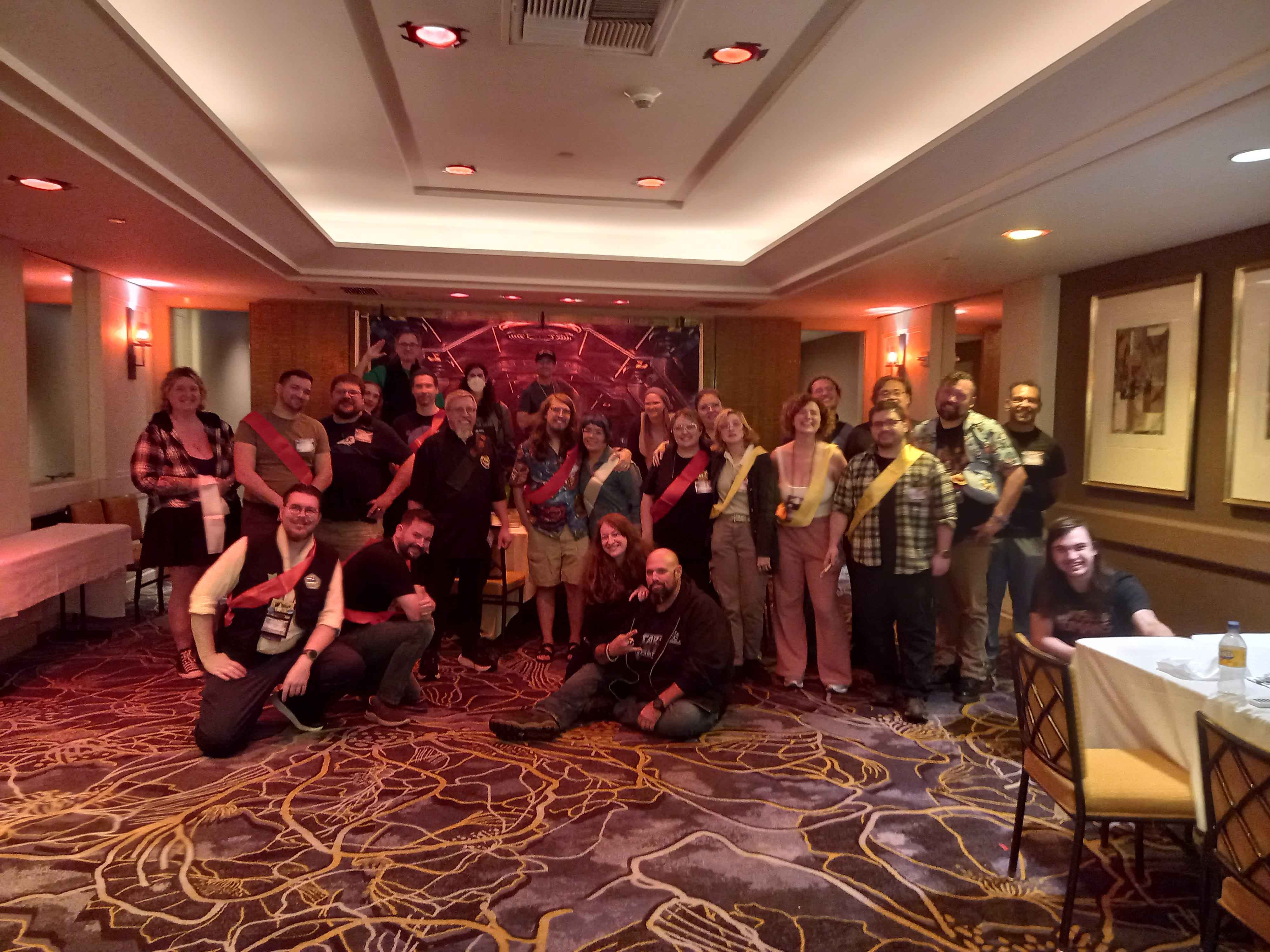
[Picture taken at the end of “Starship Valkyrie Basic: Kackistocracy” at Strategicon Gamex, May 2026. United and Strong!]
One of the worst places where a game master can find himself is staring down a room of enthusiastic players who are asking to repeat a particular action that worked a little too well in a previous game.
It’s a very difficult place to be, because most games have a presumption of a static ruleset, and players expect that strategies that work will continue to work. If, however, aGM gave an unduly advantageous ruling, it can result in a significant change to the way that the game is played. A heretofore unknown or fringe tactic can quickly become the cornerstone of player strategy, and from there, it can move into a doctrine of the player meta. Our offensive meta in Starship Valkyrie, with its upside dominated by phase missiles, ramming actions, and decimator raids, is caught in this particular trap; every single one of those tactics came about as an unintended side effect of GM rulings.
In the beginning there was darkness, then Poobah said “let there be lasers,” and there were, and they were mid. By default, since Version Zero, an SSV ship has had a pair of laser turrets that deal 2 TJ damage every five minutes. They could consume reactor boosts for an extra TJ of damage. By Version 1.X, they were overwhelmingly used to support starfighters. Against a Praezorian warship with 1 armor, the lasers typically only net 1 damage, and with the ability Laser Turret Strafe on a weapons tech, each could kill three drones, usually the most valuable action they could take. (An enemy warship had twenty drones, and drones chew through the shield very fast if starfighters don’t destroy them, and pilots can and often did die fighting drones to keep them off the shields, making laser support from the main ship guns extremely valuable.)
But in addition to the middling lasers, we had two kinds of nuclear missiles that dealt 3TJ or 5TJ damage each. They could be shot down while flying to their target, but they hit hard and won fights. Thus the first meta: missiles destroy warships, fighters intercept drones (who can also destroy missiles), and lasers support fighters.
Everything changed with the invention of the phase missile. Illegal in the game’s fiction and initially difficult to produce, it skipped into hyperspace, teleporting onto the enemy ship and, if it hit, dealing about 7 TJ damage while it ignored armor entirely. It was cool, scary, unreliable, and tremendous fun—and devastatingly effective. It went from “we might go to jail, but we’re going to live,” to “well, fuck it, we got away with it last time,” to “it’s doctrine and on-ship policy to use phase missiles,” all within a few months.
The standardization of the phase missile as the principal weapon of the Earth Republic was a massive paradigm shift, both within the narrative and gameplay. For a ship playing under the Advanced ruleset at the time (then the only ruleset), the ship’s principal offensive capacity was limited by an initial missile loadout, usually fifteen phase missiles on a Destroyer, and Engineering’s loadout to the all-important secure canisters of uranium, which could produce another twelve phase missiles unless more canisters could be attained. At seven damage apiece, this meant that the ship could very effectively deal about 150 damage via missiles before slowing down its damage output dramatically. There are some caveats on that, as engineering cannot produce those 12 missiles as fast as the missile launcher can fire them, but the first 150 damage dealt in a scenario was essentially free. The practical upshot of this meta was that a difficult scenario had to include at least four Praezorian warships, as they have fifty hit points each—and that trying to fight off six over the course of a game was miserably brutal.
The war ground on, as they are wont to do, and each side’s weapons evolved. The Earth Republic bought and standardized pulse cannon technology from the Skelow, adding a range-dependent plasma weapon to the ships’ arsenals, which deals 4 TJ at range 1 LS, 3 TJ at 2 LS, 2 TJ at 3 LS and 1 TJ at 4 LS. Praezorian drones (the starfighter enemy) developed armor, and then starfighters developed heavier ammo, which limited their number of attacks but allowed much more damage-per-hit (up to 3 TJ/hit with 10 decimator rounds, or 2 TJ/hit with 20 inferno rounds). There was a game about our own strategic scientific advancements to more effectively fight the war, and we improved our phase missiles further to an average of 8 TJ damage per hit.
At this juncture there was a huge rules overhaul. Starship Valkyrie 2.0, which rapidly became 2.04 based on a few enterprising munchkins needing to be swatted on the nose for early exploits. This ruleset, critically, greatly changed how Science worked. I skipped over Science Modifications in the 1.X overview because they were, frankly, underwhelming. Difficult, dangerous experiments had wildly unpredictable and often terrible results. They contributed to damage but only tangentially so. With 2.X, each modifiable system had a standard suite of four upgrades that Science could achieve and apply, and the traditional activity was to take many minutes (starting at fifteen and gradually whittled down to eight) to apply all four beneficial effects. Lastly, from a ruling during a side story, it was established that the hardpoints on a starfighter that could carry and launch phase missiles to do bombing runs.
This set the stage for our next evolution in the meta, the 2014-2015 “Third [Praezorian] War” Era. Because a Destroyer’s six Apex Starfighters each had two hardpoints and because those were now valid places to put a phase missile, players began to ask “hey, can we start with an extra twelve phase missiles already loaded onto our starfighters?” While playing as captain of the Hydra, Poobah himself asked Tara and me this question while we acted as guest GMs for the universe (yes, we took over the SSV universe for a whole summer right after getting together). We in turn asked him if that was the durable ruling he wanted, because if he was allowed to do it on the Hydra, we would of course be able to do this as player captains of the Odyssey and Valkyrie respectively. For reasons that mystify us to this day, he said fucking yes. So, okay, great. Now every Star Destroyer has an effective 39 phase missiles, and every starfighter is a pair of missile launchers, and every Earth Republic Star Destroyer can credibly deal (27 * 8) 216 TJ damage in the first three minutes of battle, against enemies who deal 7 TJ damage every 7 minutes. Furthermore, the “two hits per starfighter per two minutes” strafing run, born of fighters hitting for more than 1 TJ and therefore being about to damage an enemy ship with armor, meant that the new “Decimator Raid” (the starfighters evade or bypass the enemy fighters and just drop their ammo on a capital ship) could now deal 24 TJ every two minutes (to an enemy with 1 armor, which was common) or 120 TJ per sortie.
And then there were the variant ships, like the Odyssey-class Star Destroyer, which also had effectively useless “weapons platforms” that were ineffective as intended in battle (unmodifiable and unboostable lasers or pulse cannons hanging around outside the ship and vulnerable to capital ship fire), but which, when turned into missile launchers, loaded an extra five phase missiles apiece. Poobah agreed the Odyssey began with an extra ten phase missiles on the platforms, which the bridge immediately grabbed ritualistically from the platforms in the middle of each combat game and proceeded to blast them from the bridge’s missile launcher. While this was marginally better than wingtips (Odyssey’s three Blades and an Apex had five hardpoints to the standard twelve), it certainly maintained the extreme firepower of this era.
But wait! How can we deal with incoming starfighters if our starfighters are busy acting as fighter-bombers? Well, you remember those science changes from three paragraphs ago? One of the new powers for the Pulse Cannon was the all-important Free-Energy Buildup (lovingly called a FEBU), which allowed a single shot to add greater-than-linear bonus damage per Reactor Boost spent on the cannon, and if the final hit was 10 TJ+ damage, it would cause ⅓ its final damage to every single enemy in a single 1 LS square. Like, say, each of the 60-100 2 HP Preazorian Drones that were meant to take the starfighters twenty minutes and much heartbreak to destroy.
So, we now have a meta in which the best anti-ship weapon is the starfighters (who bypass their normal game because bombing is “easy”), the best anti-fighter weapon is the Pulse Cannon with Science’s blessing, and the already rapid one missile-per-minute missile launcher is nearly obsolete next to opening the hangar doors and having the starfighters launch wing-tip missiles directly into hyperspace for 12 missiles per two-minute cycle (I mean, until you run out of missiles after the second volley, but most things were very dead at this point). The lasers became nearly a non-participant (their upgraded damage was approximately 8 TJ / 3 minutes between the two turrets, which would’ve been respectable several paragraphs ago), unless you had a Skelow on your bridge and could turn him into a bodhisattva for twenty minutes by stacking all possible timer-reducing abilities. But the depths of timer manipulation are another meta for another day.
Lastly, for reasons of pure perversity, I should mention ramming. A Destroyer deals 20 TJ to an enemy and 20 TJ to itself with a ramming action; smaller ships deal less, but twenty is the typical number. This is an excellent answer to the question “can we ram them?!” and usually ended debate; 20 TJ of damage to deflector shields was at least eleven damage to the ship and that’s probably eight console repairs and a hull breach, and as you see there are much easier ways to deal twenty points of damage. Unless, of course, you had a card that made you immune to damage for one hit, like the Dark Matter Halo shield modification, in which case you could choose to use it to ram an enemy ship before they could fire again, because 20 TJ can be a lot of extra damage after missiles are depleted, and Dark Matter Halo means it’s functionally a free hit.
This is the era in which we largely went from fighting near-peer adversaries to fighting monstrosities that got to bend the rules; unliving ships that took half damage from everything and hit back for hellish numbers (the Dead), or extra-dimensional invaders who shunted phase missiles outside their obscene 5-armor shells (the Pyramids). Or the fucking fish with swarms of ships that attacked every minute for escalating damage, who had to be burned off instantly to avoid roasting the player ship (the Z, A.K.A. Murder Tuna, discussed in much of the fiction).
And then we just did that for several years. There wasn’t really a way to de-escalate without a new rules edition; the game was still fun, but the actual plan of attack was bonkers most games. And this, this apex of PC damage out and the nadir of gameplay, is what I wanted to sit with in this post. We spent years asking, basically, how we got here and how to get out. The primacy of the phase missile wasn’t a mathematical quirk; it came out of years of roleplayed and hard-won “military” doctrine, and the players therefore cared about it. Phase missile primacy is part of the fiction. It was the defining weapon of the Earth Republic, and the weapon that won the war for five successive wars. It was an integral part of Starship Valkyrie; the missiles are wild and random and devastating, until they are gone. But every other pillar of the attack plan was still hard to take on; hardpoints themselves had been canon since the beginning, and it was very hard to explain why you couldn’t put missiles on the starfighters in port if you were going to do so in space anyway. Decimator rounds existed in the world, and starfighter attack timing was very well established; a bombing minigame could have been added (and may still be added, but…), but it wasn’t obvious how it could be harder to hit a ship that was orders of magnitude bigger and slower than a fighter’s intended target.
To curtail the excesses of this era, we played on a lot on the ships without full starfighter wings, or the ones using Blade-class starfighters with only a single hardpoint thereby greatly reducing missile loads. The community eventually rolled back the wing-tip rules (that is, rejecting the bonus 12 missiles on gamestart) as being caused by an “incident” aboard another ship, but not before years of misuse, and even then “cannot start with” and “cannot fire” were very different rulings; firing from starfighters became “impolite” though never fully “impermissable.” At this point, players were so brutally effective on offense that the worst excesses became, essentially, uncouth; you could deploy them, but you might shorten the game to a few frenetic minutes and a great deal of idleness. Better to fight the old way and let everyone participate.
With the Advanced 2.5 ruleset (released in 2025, replacing 2.04 from 2014), we made a few firm changes. Fighters can no longer effectively aim phase missiles—there are rules if you insist on doing so anyway, but they’re intentionally not published and officially a bad idea—and energy weapons got a subtle boost with both abilities and Science changes. Ramming remains a god-tier balls-out offensive move, but Dark Matter Halo caught a nerf that will give everyone on the bridge Hyperspace Sickness at those damage numbers. (For non-players, Hyperspace Sickness is a debilitating status effect that comes with one damage and seriously fucks you up and sends you to Medical.) Decimator Raids still kick moderate amounts of ass if you can land them; Free-Energy Buildup was nerfed to only destroy ten fighters, which makes it far less credible for that purpose, so you probably need your starfighters to dominate in Hotzone, and the ammo rules changed to make the per-sortie damage marginally less horrifying (but vastly more complicated). Phase missiles still dominate, and it is very likely that future enemies will have resistances or defenses against them to reign them in a little—it’s high time that the universe wised up to them in the fiction, anyway. This is not only a rules matter, but important to the simulation and the narrative.
If you’ve played with us at Strategicon but not on a private ship, you’ve encountered this through the wholly more restrained SSV Basic ruleset. Much of the playbook is the same, although your Science Mods are weaker, and your starfighter ammo capacity is even more limited for Decimator Raids (though, to be clear, they were highly effective in the two of the last three games). However, for Basic, you are not limited by Uranium. The Basic rules as Christian originally wrote them do not explain how to make a phase missile, because they were intended to cover playing events anywhere from 2130-2160, and the standardization of phase missiles varies wildly in that period. But, since we’ve been retelling the Second Praezorian War (specifically 2152-2153), and that was the height of phase missile doctrine and standardization, we’ve had to make it straightforward for Engineering to build them again, and they are once again dominant on the battlefield.
It’s fascinating to watch a similar offensive meta and doctrine of play develop independently among a different group of players and in a different ruleset. While the different eras and rulesets have taken the details in different directions, we’ve watched players time and again find the best way to obliterate enemies, discovering the most advantageous, off-the-cuff rulings and using them as the spear tip for victory. Players are, by and large, resourceful and highly motivated to destroy enemies as effectively as possible. Given the outsized power of the phase missile, we now quite definitively know that it is very much in the culture of the Earth Republic Star Navy to solve problems by teleporting nuclear weapons onto enemy ships, and I kind of love that for them.
Written by SSV Mechanics Lead Robert Prag, and edited and prepared by Lore Lead T.A. Leederman, with minimal contributions. Starship Valkyrie Basic and Advanced were created by Christian Brown in 2010. The world, rules, and trademarks for Starship Valkyrie are owned and operated by Robert Prag and Tara Leederman.
Want to sink your teeth into more Starship Valkyrie? Come play with us at Strategicon Conventions at the LAX Hilton, on Presidents Day, Memorial Day, and Labor Day weekends! We’ll next be at Strategicon Gateway at the end of the summer, with a brand-new Valkyrie scenario. Get your badge here!
Tara is writing fiction in the universe of SSV! She runs the sister Substack to Mechanics, over at Starship Valkyrie Fiction, and there you can read serializing novels, see what she’s working on, and hear about her latest publications in the world of Starship Valkyrie. She’s also serializing a Starship Valkyrie novel mini-series, What Remains, here. Lots of great stuff to read, including Tara’s new serializing novel, Vox Protocol!

I do love hearing how things have changed over the years. I started in 2.X and find it fascinating how those scamps paved the way for some of the gonzo games I was introduced to 😂🖤😂